Articles Tagged with: Animals

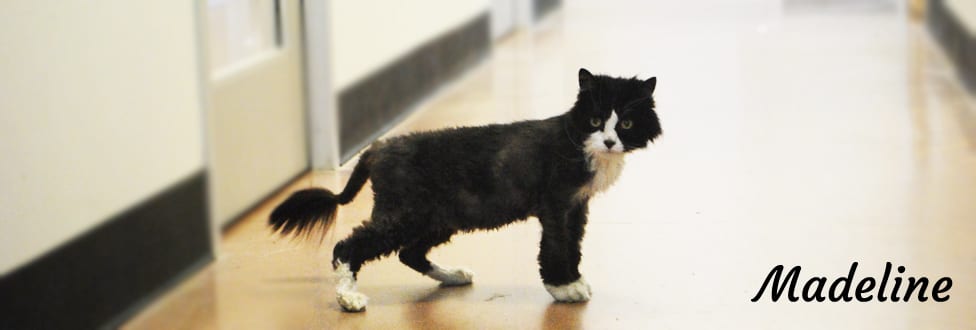
Meet Madeline!

Sweet survivor cat ready for her new home

**Update: Madeline has been adopted**

“Cases like hers are the reason that many of us got into the business of rescuing animals: there is nothing more rewarding than seeing an animal that was previously neglected transform with some TLC.”
– Dr. Kate Gollon, shelter veterinarian at the Animal Rescue League of Boston

Mad Before&AfterAlmost two months ago, a very kind person brought Madeline to our Dedham Animal Care & Adoption Center after discovering the 8-year-old cat unable to move in the backyard of her home where someone had left her. Shelter staff instantly observed the fur on Madeline’s hind quarters appeared thickly matted and that she couldn’t move her back legs.

Her sweet temperament and soft, steady purr touched the hearts of shelter veterinarian Dr. Kate Gollon and all the Dedham staff as they worked to make her comfortable with pain medications and by shaving off the mass of tangles on her lower body.

Dr. Gollon determined Madeline had nearly 4 inches of mats over 70% of her body.  The bag of her shaved matted fur tipped the scales at over a pound.  The twisted condition of her coat  had clearly forced her to go to the bathroom on herself and likely prevented her from walking for some time. Even after shelter staff shaved her fur, she couldn’t walk on her very weak back legs.

When diagnostic tests including x-rays and bloodwork did not provide a more definitive reason for the weakness in her back legs, Dr. Gollon prescribed a regimen of daily physical therapy to help Madeline recover her strength and mobility. Staff gave Madeline time post-shave to recuperate and get to know them before carefully and caringly beginning to work with her to get her walking.

At first, staff gently moved her back legs for her, three times a day. Gradually, they helped her stand by placing her in a sling to support her weight while getting her up on all fours. Once her ability to support herself improved, staff worked with her on walking across the floor and maneuvering changes in elevation.  To give her some added traction on the polished cement floors at the shelter, staff would place a touch of Vaseline on her paw pads.

Everyone at the Dedham shelter felt as proud as mamma cats watching Madeline’s amazing progress as she confidently strolled to them and maneuvered up carpeted steps for the first time!

A dedicated ARL foster volunteer brought Madeline to her home to help her re-acclimate to living with people. Though the determined kitty remains a bit unsteady on her hind legs, she shows no signs they are holding her back. According to her foster mom, Madeline loves to explore and happily curls up on the couch for a good snooze afterwards.

We’re very happy to report Madeline is ready for adoption! Scotties Facial Tissue will cover her adoption fee this weekend, so come visit the ARL’s Dedham Animal Care & Adoption Center to learn more about her.

Because of her unsteady legs, she would do best in a home with carpet.  A one-story house or apartment, or a home where she would spend most of her time in one big room or have access to her litter box and food without having to climb stairs would make for the ideal situation for Madeline.

In the words of Dr. Gollon: “Madeline is a special cat and quite a survivor!  The family who adopts her will most definitely fall in love with her as much as we have at ARL.”


Meet Rugby!

A real miracle puppy ready to find a new home

“Rugby’s story highlights all the wonderful people in the ARL network who are dedicated to helping neglected animals.”
– Dr. Edward Schettino, Director of Veterinary Medical Services, ARL

When we first met Rugby back in April, he could have been the poster child for our “See Something, Say Something: Report Animal Cruelty,” campaign running that month.

At the time, he was 4 1/2 months old and had been cruelly abandoned in the middle of the road in Fitchburg, Massachusetts. His front legs were severely twisted at the wrists, so Rugby could only get around by doing a haphazard crawl.  Thankfully, someone reported spotting Rugby inching his way along the road where he’d been left, and Lt. Alan Borgal, director of the ARL’s Center for Animal Protection, brought him to the ARL’s Boston Shelter.

When Dr. Edward Schettino, the ARL’s director of veterinary medical services, examined Rugby at the shelter, he observed the spirited young dog was very underweight. Dr. Schettino concluded the condition of Rugby’s front legs was probably due to poor nutrition and long-term confinement to a very small crate. After reviewing x-rays of Rugby’s front legs with his colleagues, Dr. Schettino preliminarily diagnosed Rugby with bilateral carpal laxity syndrome, a condition that could require surgery or could also respond to a diet of well-balanced adult dog-food and a program of rigorous exercise.

Rigorous exercise seemed to be the best course of treatment for Rugby!  A rambunctious dog, Rugby already had ARL behaviorists, staff,  and trained volunteers working with him to help him channel his energies into playing with other dogs and chew toys.

And getting him moving helped on the medical and behavioral front indeed!

Within a few weeks, Rugby’s front legs were improving. The ARL collaborated on his treatment with colleagues at the ARL and Tufts University Cummings School of Veterinary Medicine. To increase strength in his legs, Rugby began underwater treadmill therapy twice a week, under the supervision of the ARL’s Dr. Alett Mekler and the physical therapists at Animotion in Stoughton, Massachusetts, who donated their time and services.

In just under three months, Rugby has come incredibly far in his rehabilitation.  He is moving well on his front legs and his sweet, playful personality makes everyone at the shelter smile–even when he’s a bit of a handful (written with love and a smile, of course).

Thanks to the collaborative effort of our Center for Animal Protection, shelter veterinarians, dog behaviorists, shelter staff, volunteers, Tufts University Cummings School, and Animotion, this miracle puppy is now ready for a new home!

According to shelter staff, an experienced dog owner preferably with another dog would be the best situation for Rugby–the guy really needs a playmate to keep him on his toes and moving!  He’s still working on his jumpy/mouthy behavior, so an active household with older children would be more suited to his big personality and energy-level.


Baby Alert! Mini-Donkey Gives Birth to Healthy Baby

Mini-Donkey Rescued from Illegal Ludlow Petting Zoo Gives Birth in New Home

Baby Alice

Baby Alice

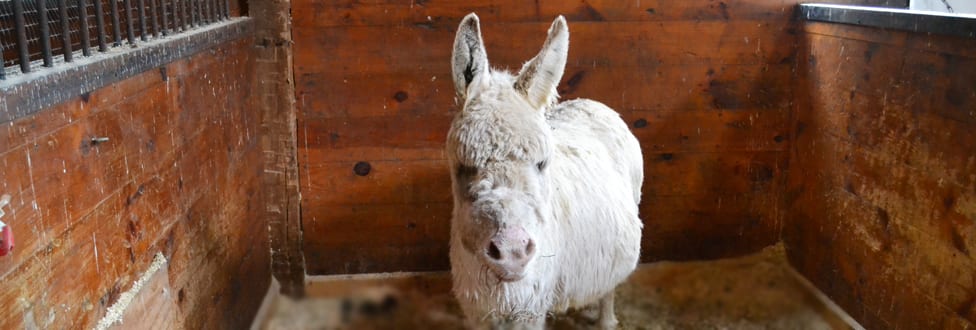
Yesterday morning Loretta, a mini-donkey who was adopted from our Dedham Animal Care & Adoption Center on March 24, gave birth to a healthy baby girl. The birth went perfectly and did not need any intervention. Both mom and baby, now named Alice, are doing well!

According to Alyssa Kane, one of our Dedham shelter agents, “this baby is quite possibly the cutest thing you’ll see in a long time!”

Congrats to the new mom and her adopters.

We are very excited to report that Loretta and Alice will be staying together! They live on a beautiful farm where mom and baby will get to foster their beautiful mother-daughter bond.

06-03-14 Loretta & Baby Donkey

Loretta is one of 35 animals that the ARL, together with MSPCA-Angell, rescued from an illegal traveling petting zoo in Ludlow, Massachusetts back in February.

Read the full story about the rescue.

Most of the animals found permanent homes, but we still have three animals at our Dedham barn from that rescue who are waiting patiently for someone to adopt them.

Ross – a pony, Phoebe – a pony, and Chandler – a goat, are all hopeful that someone will adopt them soon! You can learn more about all of them on our adoptable animals page.


Field Services Saves Juvenile Bald Eagle in Tyngsborough, MA

Eagle is Resting at Tufts

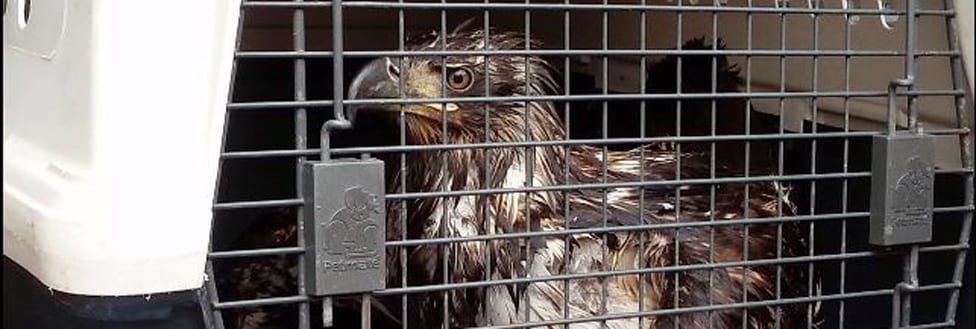
ARLhawkOn May 1, 2014, the Animal Rescue League of Boston (ARL) received a call from Tyngsborough animal control in regards to an injured juvenile bald eagle.


With the assistance of the animal control officer our rescue team was able to quickly set up their bow net which was recently donated by the Harmony Foundation, bait it with food and humanely catch the  injured bird in minutes.

The eagle was taken to The Cummings School of Veterinary Medicine at Tufts wildlife in Grafton for further care.

Watch the video of the remarkable rescue below:


Learn more about ARL’s Field Services team. 


Closing Thoughts on Prevention of Cruelty to Animals Month From Mary Nee

Today, the last day of April, concludes Prevention of Cruelty to Animals Month.

Mary & Mickey square

ARL past president, Mary Nee

Bringing greater attention to the issue is, of course, central to what the ARL does all year long, yet if you asked me why should we bring greater attention to the issue of animal cruelty, I’d say the reasons go well beyond the mission of our organization.

Reason #1: Animal cruelty is a big problem.

In 2013, the ARL assisted in the investigation of 567 cases of animal cruelty—that’s more than one case a day and we’re just one of many organizations and law enforcement agencies in the state legally pursuing animal welfare issues.

When you consider that at least 80% of animal cruelty remains undiscovered, the magnitude of the problem truly sinks in.

Reason #2: Animal cruelty can indicate other illegal activity, domestic abuse, and mental illness.

Animal cruelty can take many forms.  The intentions behind deliberately inflicting injuries or failing to provide minimum care and nutrition can vary.

Sometimes an animal is physically abused or denied basic care for sport or other financial gain, as in the case of staged dog fighting.  Other times, an animal is intentionally harmed to physically or emotionally intimidate a partner or family member.  In still others, a hoarding compulsion quickly overwhelms an owner’s ability to provide basic care and nutrition to the animals living in the home or on the property.

In each situation, however, the safety and well-being of animals, people, and our communities are all potentially at risk.

Startling statistics remind us of the strong connection between animal cruelty and other forms of violence and criminal behavior.  In a Massachusetts study, for example, 70% of animal abusers had criminal records including crimes involving violence, property, drugs, or disorderly behavior (Arluke & Luke, 1997).

Reason #3: What we do to address animal cruelty reflects our tolerance for other forms of family and community violence.

Heightened awareness of how animals are cared for and treated not only helps reduce the number of tragic cases of animal suffering, but also moves us closer to a more just and humane society where both people and animals are valued.

Whether it’s violence against an animal, child, or an adult, we should all do something to stop it from happening.

Reporting suspicions of animal cruelty to local authorities plays a critical role in prevention.  As we have talked about all this month, if when you see something, please say something and call your local police. 

You will make a tremendous difference in the lives of people and animals.

– Mary Nee, Past President of the Animal Rescue League of Boston


Bunnies are Not Just for Easter. They’re for Life!

Bunnies and Easter go hand-in-hand, but when deciding on giving a rabbit as an Easter gift, consider the chocolate, candy and stuffed animal toy kind first, and if you’re really serious, then think about adopting a rabbit. Adding a real, live rabbit to your family should be a well thought-out decision.

Here’s what you should know about rabbits:

  • They should live indoors.
  • They have a lifespan of about 10 years.
  • Rabbits are sensitive and can be stressed out by small children.
  • They like to chew on cords and furniture, so your home must be bunny-proofed.
  • Rabbits should be neutered or spayed or they will mark your house.
  • They make great apartment pets.

If you are thinking about adopting a rabbit this Easter remember to ask yourself the question, ‘Was I interested in a rabbit before Spring or am I getting caught up by the holiday fever?’ It can be an exciting surprise to add one to your family at Easter time as long as you have considered the commitment and the care that will last long after you’ve devoured your last Cadbury Crème Egg!


Lt. Borgal on the Link Between Animal Cruelty and Community Violence [VIDEO]

As a reminder that April is Prevention of Cruelty to Animals month, today we’re sharing a video featuring Lt. Alan Borgal, the Animal Rescue League of Boston’s (ARL) Director of Law Enforcement. Lt. Borgal emphasizes the link between cruelty to animals and family and community violence and encourages you to contact local authorities if you suspect animal cruelty or neglect. Remember YOU can give a voice to the victims of animal cruelty, if when you see something, you say something!

A very special thanks to GreatGrandPaws for producing the video for us!

Not sure if it’s animal cruelty? Learn the 7 warning signs.


7 Warning Signs of Potential Animal Cruelty

Subtle indications that may indicate an animal is at risk

While most of us recognize that punching, kicking, burning, choking, or hitting an animal with an object are acts of animal cruelty, there are also several more subtle warning signs of animal cruelty to watch for that could indicate mistreatment, neglect, or abuse:

    1. Howling or barking for a sustained period of time or hearing an animal cry in pain with higher pitched, more persistent vocal sounds than usual.
    2. Singed, matted, chronically or excessively dirty hair or fur.
    3. Wounds, unusual scars, hair loss, frequent limping often on different legs, or signs of improper nutrition such as weight loss or prominent visible ribs.
    4. Animals kept caged or tied with little room to move for long periods of time or without regular interaction with people
    5. Lack of protection from the weather or fece- or debris-strewn living areas for animals.
    6. Collars, leashes, or halters so tight they visibly dig into the animal’s face or neck.
    7. A large number of animals coming or going from a property.

If you know or suspect animal cruelty, report concerns to your local authorities.  Learn more about how you can prevent animal cruelty at arlboston.org/take-action


Invest in Animals This Tax Season

Donate on Line 32f of Your Massachusetts Tax Form!

If you need something to look forward to this tax season, consider this: cat and dog together with text

By donating on line 32f of your Massachusetts tax form, you are making a difference in the lives of animals in our state.

Your donation to the Massachusetts Homeless Animal Prevention and Care Fund will help the state’s most vulnerable animals: those who are homeless and those who are owned by families unable to afford to spay/neuter their pets.

Created by Chapter 193 of the Acts of 2012, the Homeless Animal Prevention and Care Fund will help animals by reducing the number of homeless cats and dogs and will provide training to animal control officers.


Your Winter Pet Health Questions, Answered

Dr. Schettino’s Answers to Pet Health Questions from ARL’s Twitter Chat

01-11-14 Dr SchettinoThank you to all who participated in and submitted questions to ARL’s Twitter chat with the ARL’s President & CEO, Edward Schettino, DVM, PhD, CAWA.

Introduction: @ARLBostonRescue: Hi everyone. Our Winter #PetHealth Twitter chat starts NOW! #ARLAskaVet

Q:@pawspluspals: @ARLBostonRescue #ARLAskaVet Should dogs always wear doggie boots/booties when they go walking on snow/ice?
A:
Dr.Schettino: Doggie boots help protect your companion’s pads from salt and ice so depending on location they can be helpful. #ARLAskaVet
A: however, some dogs may not like them #ARLAskaVet

Q: @ubergirl4: My cats shed a lot during the winter and get indigestion from hairballs. What should I give them to help?” #ARLAskaVet
A:
You should give them love and affection by grooming them on a regular basis. This will help reduce shedding! #ARLAskaVet 

Q: @Dobrska: How do I remove sap from my pet’s fur? #ARLAskaVet
A: The best way to remove sap is to use some type of cooking oil (Olive oil ..) and gently rub into the sap. #ARLAskaVet
A: ‏
Once the sap is lose you then can use a liquid dishwashing detergent to wash out the oil. Problem solved!! #ARLAskaVet

Q: Do dogs need flea/tick treatment in the winter if they rarely interact with other dogs?A: Yes! Fleas can live inside during the winter months. Year round protection is very important. #ARLAskaVet
A: And depending on the temperature outside and your location … ticks can still be a nuisance during the winter months. #ARLAskaVet
Q: @MRegan102205: #arlaskavet – If someone has an indoor/outdoor cat, when is it too cold for the cat to remain outside?” 
A: When the temperature starts to dip below freezing you need to be very careful with outdoor pets. #ARLAskaVet
A: You need to keep a careful eye on your cat when they are outside. They will let you know when it is too cold. #ARLAskaVet
A: If it is too cold for you … your cat is probably cold as well! Be very careful and monitor your cat carefully. #ARLAskaVet

Q: What is the longest a pet should be outside when the temperature is below 32F? #ARLAskaVet 
A: Some pets love the cold weather and can spend hours outside in the snow and cold. However, you need to keep a watchful eye #ARLAskaVet
A: on your pet and when they show signs of cold: holding up their paws, shivering and becoming less active #ARLAskaVet


Q: @BostonDailyNews: Can animals get frostbite? #ARLAskaVet #Boston cc:@ARLDrS
A: Yes! Usually on their paw pads, the tip of the tail and the margins of the ears. #ARLAskaVet #Boston

Q: Cats seem to eat plants frequently during the winter. Why and is this a cause for concern? #ARLAskaVet #Boston cc:@ARLDrS
A: You are either home more often or you have moved your plants inside for the winter months. #ARLAskaVet #Boston
A: It is vital that you are familiar with what type of houseplants you have and their degree of toxicity! #ARLAskaVet #Boston

Q: @AlyssaKane: @ARLBostonRescue @ARLDrS Should I vaccinate my dog for lepto and canine flu? I’m not sure if I should be worried about these illnesses #ARLAskaVet
A: It all depends on the lifestyle of your dog. You should have this conversation with your local veterinarian.

Q: @CamillaRFox: @ARLBostonRescue @ARLDrS #ARLAskaVet Any winter exercise tips for large dog whose arthritis lets him swim, but little else?
A: You can find a canine physical therapist who generally have underwater treadmills that you can use.

Q: @norwoodsworld:@ARLBostonRescue @ARLDrS what’s the difference between kennel cough and canine flu? #ARLAskaVet
A: Great tweet! They both have similar symptoms but are very different – canine flu generally contd #ARLAskaVet
A: … is more severe. You should speak with your regular veterinarian regarding risks of each. #ARLAskaVet
Q: When should a dog wear a coat? #ARLAskaVet
A: It all depends on the dog. If you feel your dog is uncomfortable in the cold, feel free to try a warm winter coat.
A: Generally dogs lose heat through their paws, ears and respiratory tract.